Saturday, 28 March 2015

Slacker (1991)

'I think I got really lucky with Slacker. That was a film that probably shouldn't have been seen.'
- Richard Linklater

'Slacker' is a film formed from a series of vignettes that weave and blend in and out of mostly nameless, insignificant citizens of Austin, Texas. The entire premise of 'Slacker' ties in with Richard Linklater's character's (named 'Should Have Stayed at Bus Station') idea of realities separating off into alternate tangents depending on the decisions we make. 'Slacker' plays on this, with the film wondering down the alternate paths of other characters, rather than focusing on just one of them.


'Slacker', although interesting, has left me feeling just as lethargic as all of its "slacker" characters. The film encompasses the feeling of lazy sunny days and has a distinct lack of energy in its camera movements, aesthetic and in its characters. The film highlights the mundanity of these "everyday" lives, losing touch of reality in both a profound sense and literal, psychological sense in some cases. The distinct lack of a soundtrack causes 'Slacker' to seem hyper-realistic and completely grounded, with the only music being diegetic sounds from speakers (bar the ending) and live performances, giving the film a super-8, documentary feel. The live music features dead-end lyrics and furthers the frustration of the characters who are trying to find some kind of meaning in their lives. The script is full of characters spewing out profound drivel that is meaningless in the grand scheme of things but helps give the "slacker" lives more meaning. The entire film is juxtaposed with eccentricity and lethargy and Linklater captures the bizarre yet drowsy mundanity of Austin. 


The final scene, however, is full of energy and music but this is bittersweet. The characters on screen are seemingly younger than the film's other characters. To me, it seems like a statement about the naivety of youth and the blissful nature of their lack of awareness about their "slacker" fates.


Whilst Linklater's 'Boyhood' is more to my taste, I found 'Slacker' a very interesting watch and felt like it would be right at home if it was playing in a gallery.

Friday, 27 March 2015

Bowling for Columbine (2002)

'Bowling for Columbine' runs deep with subtle humour but the film's content is far from humorous. Instead, this comedy serves to highlight the shocking normality and mundane nature of gun violence in America, as well as the immune attitudes that American citizens appear to have towards it. Whilst the documentary's satire helps Michael Moore to deliver his agenda with a punch, the film also tackles several very serious issues about gun crime.


One scene that particularly stood out to me when watching 'Bowling for Columbine' was the one in which Moore pulls together a collection of old footage portraying a multitude of victims of weapon-based violence all around the world and across the history. These images of dead bodies and victims being shot would be harrowing enough on their own, but Moore plays Louis Armstrong's 'What a Wonderful World' over the top of them with cruel sarcasm, similar to the shots of poverty in 'Roger & Me' with the Beach Boys' 'Wouldn't It Be Nice' playing over the top. The juxtaposition between the music and the violent footage is brutal, making the footage seem ever more appalling and chilling.

Moore's interview style resembles that of an interrogation in many cases, portraying the people that he interviews as "villains". However, in more vulnerable moments, Moore eases up and demonstrates a more reassuring, human nature to those that he believes deserve sympathy, such as when he speaks to a teacher about the Buell Elementary school shooting.


What stands out the most about Moore's style is that he uses subtle humour, sarcasm, irony and satire to drive his points into the audience, as well as subtly ridiculing some of his interviewees like an inside joke that Moore and the audience are in on. Without this style, maybe 'Bowling for Columbine' would be just another documentary about gun crime and it wouldn't be quite as hard hitting and subtly manipulative as it is.

Thursday, 26 February 2015

Palo Alto

After having a little wander around the internet, I realised that Palo Alto has come under a lot of criticism, mainly for its somewhat vapid depiction of teenagers and its drifting plot. I, however, think that's the charm. The teenagers in the film are exactly that: people crossing the unstable and aimless bridge bridge between childhood and being a young adult; experiencing their first everything and allowing themselves to be consumed by the most seemingly unimportant aspects of their lives. The weightless plot furthers this idea and captures that sense of how significant moments and significant people float out of the teenagers' lives as quietly as as quickly as they float in. Maybe the adults behind Palo Alto's criticisms are simply writing with a strong, jealous sense of nostalgia for those long-lost years.


Palo Alto is based on a collection of short stories written by James Franco and is centred around 4 specific characters and the way in which their lives interweave. The first is April - she is an introverted character with a distant and detached family, a somewhat poetic smoking habit and an inappropriate relationship with her soccer coach (Franco) borne out of her distinct lack of attention and established worth elsewhere in her life. She is also incredibly set apart from her friends because of their destructive and competitive attempts at friendship. Next comes Teddy, the similarly introverted love interest of April with an unfortunate tendency to release his emotions through alcohol, drugs and wild mistakes, despite his caring nature. Teddy's closest friend is the unstable and unpredictable Fred. Fred is an incredibly interesting character because he seems to have a series of layers in his personality. The brash and careless yet fun layer, the violent, cruel sad and manipulative layer beneath that and, finally, the rarely-seen layer of sadness and fear. There is someone like Fred in every friendship group you might come across. The fourth character is the less featured Emily who is disregarded and abandoned throughout the whole film by many characters due to her sexual reputation but pensive shots give the insight into her loneliness and sadness.


Whilst Palo Alto's ending is stunning in every sense of the word and there are some really thought-provoking parallels in the film, I'd have to say that my favourite part is the 10 minute long party scene close to the start. It kick-starts through Palo Alto's fog and it makes use of a really dreamy and surreal soundtrack. The first shots in the part are of April's "friends" playing 'never have I ever', where they all find distorted pleasure in embarrassing each other through a series of incredibly specific 'never have I evers'. April is physically and emotionally distant from them and can be seen wandering through the party aimlessly with a slight air of boredom and discontent. She sits next to Teddy, who lights a cigarette for her, whilst Fred is sprawled on the floor drinking out of a vase. Despite Fred's melodramatic disapproval of April's company, the three decide to leave the party for a while in such a way that furthers the "outsider" focus of the film, screaming out that teen angst/not like other teenagers attitude. It is a wonderful blend of both 'absorbing' and 'cliche'.
The three run past the game of 'never have I ever' as our 4th character, Emily, claims 'I've never been in love'. Using a lampshade as a megaphone, yet speaking calmly, Fred responds to her statement with 'I think that's bullshit', before the three continue to run past in a lethargic yet fleeting movement. They run outside, laughing, as Fred yells 'I stole your lampshade'.
They run through faint rain in slow motion and Teddy reaches out to take April's hand in a moment that really drives their fluctuating love forward. Passing time in a graveyard and carving hearts into trees, the three of them smoke and exchange vaguely painful overly-profound comments whilst the party begins to become out of control. When they finally return, the film's soundtrack kicks in even more and consumes the on-screen action whilst the three are instantly separated from the moment they walk through the door. From this point onwards, cue a series of preoccupied and subtly anguished gazes from April and Teddy as they watch each other find drunken comfort in other people and cue Fred hinting at his hidden emotional depth as he sings and plays the piano. A lovely little detail in the film is the nameless teenage boy leaning at the bottom of the staircase in a heavy, drunken mess. The entire party scene is thoughtful and explorative, very pitiful and all so consuming.

The film is incredibly interesting in many other ways, especially with such a controversial and inappropriate relationship between April and the soccer coach and the way her character has an emphasised air of youth around him. April's superficial and insecure friends are another point of interest, as well as her preoccupied mother and Fred's father's ambiguous sexuality and inappropriate actions. As well as having so many aspects that can be explored deeply, the film's cinematography is beautiful and surreal and it really mirrors the narrative.
Palo Alto is a striking film, but not one for people who are bored easily because the empty, lethargic and aimless atmosphere of Palo Alto is its beauty.

Tuesday, 30 December 2014

God Help The Girl - response

God Help The Girl is a musical that came to my attention because Stuart Murdoch, of Belle & Sebastian, wrote and directed it. Belle & Sebastian are labelled as an indie-pop band and the indie-pop influences and twists are constant throughout this quirky musical.


I may or may not have watched this film three times within 24 hours... It's not unusual for me to rewatch films regularly, but there was just something very captivating about God Help The Girl - like a certain feeling of mystery that left me wanting to explore the film a little bit more.

God Help The Girl has moments of comedy and is generally very charming but, unbeknownst to me initially, it's actually quite dark and heavy in subject matter. Eve, the protagonist, suffers from anorexia but also has a vaguely nonchalant love for singing. The film drifts with Eve as she meets fellow musicians and good friends, James and Cassie. There is a love interest, of course, but it has a subtle and indirect focus and Eve is torn between her awkward friend James and her German "dream boy" (I'll Have To Dance With Cassie).


At first, God Help The Girl's musical numbers and voiceover effects perplexed me but I've grown to love them and see how they add to the charm. The voiceover effects also echo that of radio presenters which is a nice little music-related decoration to the film. God Help The Girl also has a certain retro feel to it through the cinematography and some of the outfits to the point where the time period is still irrelevant and ambiguous even when technology from this decade features in the scene.

All in all, God Help The Girl is a charming, quirky little musical film and definitely worth a watch - but it deserves two or three in order to really appreciate it!

Friday, 12 December 2014

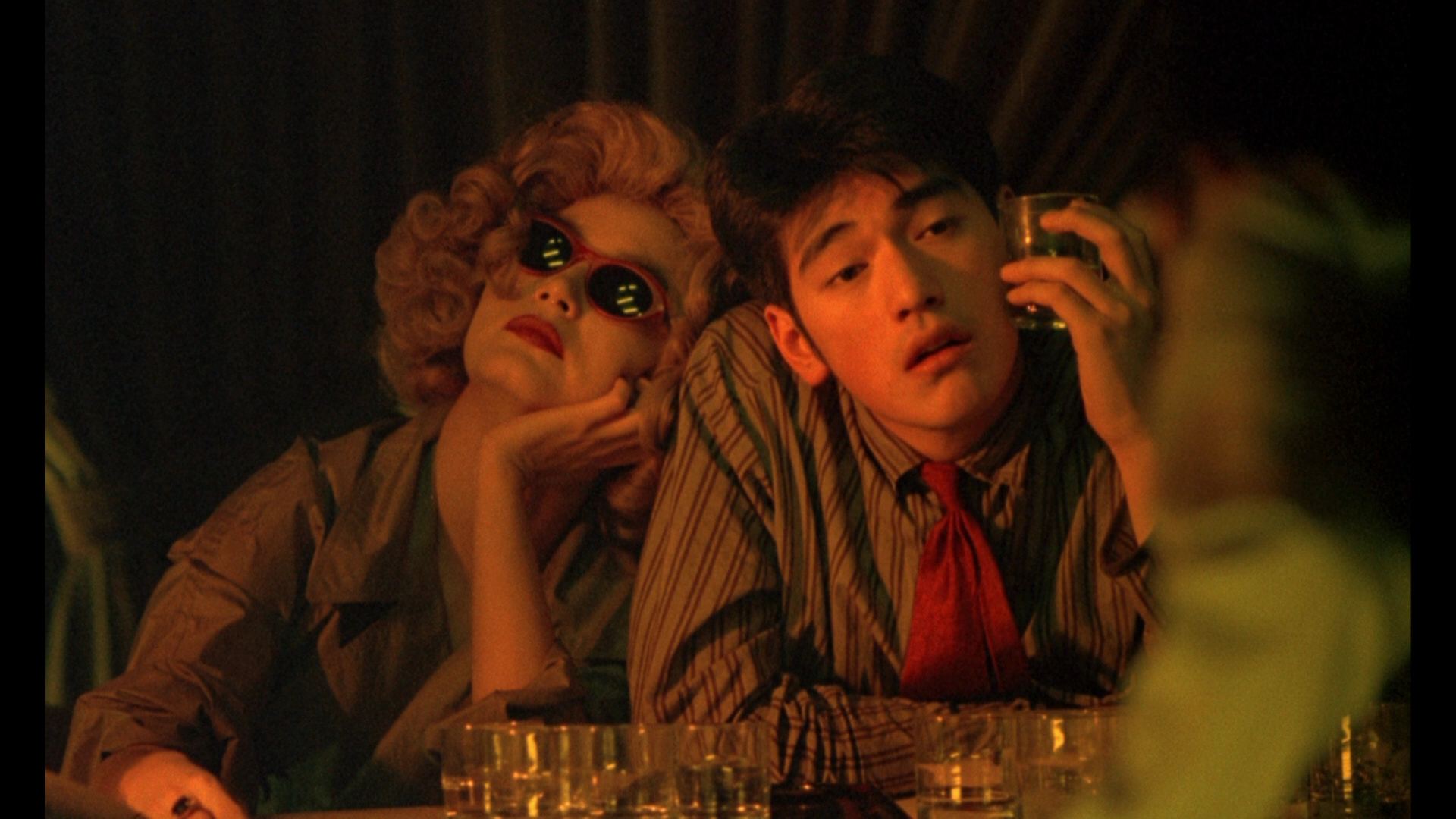
Chungking Express (1994) - response

Chungking Express is a very interesting film to watch in regards to style, although I found it slightly difficult to follow at times (mainly during the first narrative). That being said, each character in the film is so complex and is explored in such depth that it makes a really intriguing watch.
I feel that there's a definite similarity between the first cop (cop 223) and the character of Oliver Tate from Submarine. They both have a certain way of being quite melodramatic and poetic and this actually reinforced the slightly more pathetic characteristics of cop 223. Leading on from this, the gender representation in Chungking Express was interesting - whilst the male characters had a tendency to be quite weak and submissive, the female characters assumed a lot more strength and conviction.
Chungking Express can be applauded for how well it creates a sense of a really claustrophobic urban environment and the focus on the characters' solitude highlights the loneliness and isolation that can occur in bustling cities.

Saturday, 15 November 2014

Short Term 12


Short Term 12 is one of the best movies I've seen in a long time and it's right up there (although not quite overtaking) Boyhood, which I got the opportunity to watch earlier this year.
Short Term 12 is about a young woman working in a home for troubled teenagers, the characters that she meets and her own battles that she has to face after having masked them for a very long time. Brie Larson, who plays the protagonist (Grace), seemed vaguely familiar to me so I looked her up and I was stunned to discover that she played Envy Adams in Scott Pilgrim Vs The World - her acting is incredible and I wouldn't have ever guessed that Grace and Envy were played by the same actress.

What struck me about this film is how beautiful all the interactions between the characters are but how these interactions lure you into a false sense of security which is then completely disrupted by sudden heart-wrenching action (I won't go into detail because this is definitely something you should watch for yourself). Another great detail of the film is how it comes full circle, with parallels between the first scene and the last scene that complete the movie and make a point of how life and relationships between people progress.

The trailer includes some wonderful quotes that sum up the film better than I ever could:

'A roller coaster of emotion... both heartwarming and heartrending at once.' - The Playlist
'Brie Larson is a quiet revelation. The same could be said of the film itself.' - film.com
'The whole thing just feels perfect... a shining example of what cinema is all about' - slashfilm


This film is definitely worth a watch or two - for its subtle humour, moving narrative, stunning cinematography, incredible script and captivating characters.


Monday, 13 October 2014

Breathless (1960) / A Bout De Souffle - film response

Whilst Breathless didn't appeal to me very much in terms of the plot or style of the film, I could really appreciate some of its aspects...


The unusual editing in the film really interested me and was definitely one of the features that kept me pulled in. It felt quite refreshing to see slightly surreal continuity and editing in such an old film and it helped to revamp it a little.
The main characters were both rather unlikeable, in my opinion, but they both also contributed a great deal to the film in terms of style and a certain smoothness and suaveness. Their calm looks, sunglasses and cigarettes all helped to create their flawless and composed characters.


 There was definitely a strong undercurrent of issues around America and France and the strong differences/controversy between them. Many of the film's lines talked about the difference between American girls and French girls and comparisons between the cultures were frequent.

Breathless (or A Bout De Souffle) was definitely an interesting and worthwhile watch but I can't say that I would rush to watch it again any time soon.


Tuesday, 15 July 2014

Begin Again

I went to see Begin Again with a few people from the film studies class. It was very empty in the screen and the cinema and the cinema experience was generally nice, except the lights came on during the end of the film rather than after it finished (but oh well).
The film felt perfect in length, and actually a little short compared to the last few films I've watched in the cinema.


Begin Again was very sweet - with a few moments of comedy and drama, it was just a happy film. I thought the idea of recording their own album in various places around New York City was lovely and the characters all had such interesting depth to them. I was concerned there would be too much focus and plot dependency on the ex-boyfriend-turned-pop-legend, but I was pleasantly surprised. The focus was instead put into the character of Violet, the daughter of Dan who I had no idea would be a character in the film.
All the musicians felt very authentic and friendly and the film, although not one of my favourites, was very enjoyable and just nice to watch.
This hasn't been a very coherent response but the film was a real gem and had some absolutely beautiful moments so it is well worth watching it (and Keira Knightley can sing pretty well).

Sunday, 6 July 2014

Boyhood (spoilers)

Boyhood was an absolutely incredible film: a fantastic script, amazing cinematography, lovely soundtrack - the whole works.

People often say that they're "transported" into a film and I've never felt so completely involved in the lives of a set of characters. When I watch a film, particularly in a cinema, I tend to get a little distracted and reflect on my life. This barely happened when I watched Boyhood (which is a good thing).

There were some very interesting themes being discussed in the movie, such as domestic violence, alcohol addiction, as well as just the process of growing up.
I also thought that the "everyday" content of the script was great - the comedy all came from everyday situations rather than it being planned out and forced.

The shifts in time were so subtle and it was great to see how these individuals changed over the years, mainly in their appearance but also in the way they behaved.
I liked how the jump between the years would leave the audience to fill in the gaps. Whilst the film was almost 3 hours long, it felt like a great length. In fact, I was a little bit disappointed when it ended - not because I wanted to know what happened next, but because I had been in the middle of the characters' lives for 2 hours and 40 minutes and then suddenly I wasn't.
I kept wondering how they were going to end the film, and I was relieved to find that they didn't seize any of the opportunities to end it softly after cliche scene. Instead, the ending was very reflective (yet humorous) but so abrupt and perfect ... plus, the credits featured one of my favourite songs by Arcade Fire.
I knew Arcade Fire's track (Deep Blue) would be in the film after reading an article about the soundtrack, and I thought the lyrics suited the idea of the film well. I was pleasantly surprised to find that another Arcade Fire song was featured in the middle of the film.

I think my favourite scene had to be the one where Mason travels to his university and stops off along the way to put petrol in his car and take photos of some of the amazing surroundings, all to the music of Hero by Family Of The Year.

Sunday, 29 June 2014

Psycho

My family have had an interest in Hitchcock's films for a long time now that started when we all watched The Lady Vanishes on TV. After loving The Lady Vanishes, we went on to buy Rear Window, Strangers On A Train, North By Northwest etc and, later, a Hitchcock boxset.

For Christmas, my parents bought me a boxset of Psycho and The Birds as we have both on VHS but none of us have actually got round to watching them.
I've been putting off watching them as I feel like you need to be in the mood for Hitchcock's films, but after not being able to find the other discs from our My So-Called Life boxset, I watched Psycho.
It was very different to the image I had created from seeing the shower scene many times, but it was also a lot better than I thought it was going to be... although, it was much less scary but much more weird than I had anticipated.

I felt that Anthony Perkins, who plays the "psychotic" Norman Bates, played the part incredibly well - capturing that nice, yet uneasy feel to his character.

I found it interesting that, at the start, I wanted Marion to succeed in her running away; when she was dead, I wanted Norman to succeed in covering everything up; when Sam and her sister arrive, I wanted them to succeed in discovering Norman's secret. I wasn't rooting for one person throughout, it changed as the film progressed.

The last scene, with Norman's mother's voice, and his creepy grin at the camera was quite unsettling.


All in all, Psycho was a lot more interesting than I thought it would be, but a lot more perturbing.

Wednesday, 18 June 2014

Women on the Verge of a Nervous Breakdown


I appreciated how Women on the Verge of a Nervous Breakdown had many chaotic and crazy things going on within the plot, but kept it unique and avoided making it into a cliche Mr-Bean-everything-going-wrong type of film.
There was a focus on the relationships between all the characters in the film and it didn't have a heavier focus on the relationship between Pepa and Ivan. This made the film, for me at least, a lot more interesting to watch than had it been entirely focused on the main character's relationships.
The style of the film and the mise-en-scene was very reflective of the time, with a slightly surreal edge at times (like the view from the apartment). The style and colour reminded me of the very stylised, rather odd comedy, I'm So Excited (which I just Googled, and, coincidentally, the two films were both directed by Pedro Almodovar).


Both films feature quirky characters and fit within the comedy genre whilst dealing with the character's anxieties or drama in a humorous way. I'm So Excited also featured Antonio Banderas in a cameo role, and in Women on the Verge of a Nervous Breakdown, I didn't actually realise that the character of Carlos was played by Banderas.
Whilst Women on the Verge of a Nervous Breakdown had the opportunity to be quite slow, or have scenes that would lose the audience's interest, I found that I wasn't drifting away from the film. Almodovar has created an interesting, quirky film that I did quite enjoy (but I think I preferred the modern "throwback" style and lighter feel of I'm So Excited).

Sunday, 15 June 2014

The Young And Prodigious T.S. Spivet

(IMDB)

T.S. Spivet had a very small cast and Kyle Catlett (playing T.S. Spivet) had a certain Macaulay Culkin air about him.
I thought the film was sweet and very stylised with the perspective being from 10 year old Spivet's point of view. This was clear when my family were criticising the film for being so unrealistic and too sweet - my argument was that, when following a story with a 10 year old kid, you're not likely to get a brutal, realistic narrative (and I thought the sweet story worked perfectly with the style and feel of the film).


I loved the cinematography and mise-en-scene, and there had clearly been a lot of though put into the style of the film and into making it work brilliantly in 3D (which I usually hate).
The diegetic sounds in the film were amazing - specifically the scenes when Spivet is on the freight train.

Whilst members of my family weren't keen on the 'dead brother' plotline, I found no problem with it and thought the film was good fun to watch (and with a slight Wes Anderson feel).

In The Mood For Love - response

I thought In The Mood For Love was a really interesting film that didn't fall into the trap of typical Hollywood cliches and perfection.
I really loved the use of slow motion and music in some scenes - for instance, in this scene:


The slow motion and the reoccurring music starts and ends quite abruptly during some scenes within the film and it emphasises the romance and the time taken for the romance to blossom.
Subtle wardrobe changes helped to move along the timeline in a way that kept the flow of the film which was great.

I thought the darker, grittier style worked perfectly with the film and, again, helped to stay away from the Hollywood blockbuster look. The film felt quiet and realistic.

Overall, although it wasn't my favourite film ever, I really enjoyed watching In The Mood For Love.

Saturday, 10 May 2014

Frank/Harbour Lights Picture House Cinema


Frank was a very interesting film - definitely worth a watch. Good themes, characters, music etc...

However, I think I want to talk about the cinema experience.. Despite some rather loud popcorn-plunging and crunching near me *cough* my dad *cough*, I think that might have been the best cinema experience I've encountered.
I went to the 21:00 showing of Frank and there were just a few groups of 2 scattered around the room - I figured we could make up a row/a row and a half if we all sat next to each other. It was quiet and calm.
Tonight was also Eurovision (which I normally watch, but I'm glad I chose Frank over it tonight), a big event that takes up a lot of everyone's lives on the day.. As I was sat there watching the film, I was thinking about how great cinemas are. You lose all track of time, you have no idea whether it is dark or light outside, that facebook message or important email doesn't exist until you get home and you don't need to think about it. It's so nice to be extracted from everyday life to sit in a dark room and experience entertainment like this.
What fascinated me about tonight was that when the film ended, no one moved. Everyone was still sat there, soaking up every second of the credits with each other. It was actually very sweet to see couples still cuddled up, people still reading off the screen, sitting back, motionless, enjoying the music and appreciating everything they had just seen.

So.. shout out to everyone who made that cinema experience perfect - everyone who proved exactly why cinemas should still be around and why Harbour Lights Picture House will always be my favourite cinema.

Wednesday, 7 May 2014

Safety Not Guaranteed


Safety Not Guaranteed was a nice little movie that was a perfect mix of everything. Comedy, romance and a main plotline that is based around figuring out this mysterious, potentially insane man and his plan to go back in time.
At first, I was unsure of the characters and actors. I've seen Jake Johnson as Nick Miller in New Girl and Aubrey Plaza as Julie in Scott Pilgrim Vs The World. I was hesitant about whether their characters would work, given Plaza's deadpan style and the demolishing of Johnson's previous innocent and flappy character from New Girl to a somewhat vile, composed man in Safety Not Guaranteed.
However, I was proved wrong - they worked incredibly well.

The characters of Darius and Kenneth were intense, with Kenneth being almost scary due to his potentially mad characteristics and unpredictability. You didn't feel safe, but wanted to through Darius' clear feelings for him, shown by the way she looks at him and smiles around him. (Kudos to Mark Duplass for creating such a uneasy character).

I thought the mystery surrounding the concept of the time travel was brilliant. You really don't know what is going to happen - it's restricted narrative at its finest. (And I'm not going to say what happens - spoilers).

Definitely worth a watch.

Saturday, 3 May 2014

We Are The Best!


We Are The Best! is a Swedish film set in 1982 about 13 year old punks.
It has this incredibly realistic feel about it, through the use of cinematography and diegetic sounds which can either be a good thing or a bad thing. In this case, it suited the film very well but I feel that if I hadn't been stuck in a cinema, and I was watching it by myself, I might get bored.
In terms of plot, I appreciated the fact that it didn't have the big Hollywood movie plot of introduction, problem, resolution. Instead, it focused in on just a moment in time in these girls' lives.

It was amusing in places due to the script and its funny way of documenting the way young teenagers think. Moments that stood out were how slight feelings for a boy were discussed as being 'in love' and freaking out about a small cut on a hand: "I don't want to die!".

The character of Karla was interesting. She would be a bit of fun to be around, but any longer than a few minutes, I could see myself getting very irritated with her. Karla captures the essence of pesky year 7 students that push the boundaries a little too far.
The more subdued character of Bobo was just as interesting and is the one that gets left behind by everything and everyone.
I feel like there is a character for everyone to relate to in the film, be it the wannabe punks full of pretentious rebellion or the quieter characters getting upset by the tiniest of things.
The advert says it all: a film for everyone who's 13 years old, a film for everyone who will be 13 years old, a film for everyone who used to be 13 years old. 

(Although, I must admit that my favourite character had to be Karla's dad who gets an undignified yet hilarious appearance during the credits and several very funny scenes).

Tuesday, 8 April 2014

Eternal Sunshine Of The Spotless Mind - bookstore scene


Like Donnie Darko, I had this film on my shelf for a long time, completely unopened. Thanks to August, I decided to watch it last night and this scene stood out to me a lot. The film and it's aspects of mise en scene, cinematography etc have a lot of meaning because the film is so surreal.
This scene is set in a bookstore and throughout the scene, the books on the shelf are turned around so that the shelves are white and blank by the end of the scene.
Not only does this show how all the colour, memories and stories are being taken away from the main character (Joel), but the contrast between his dark clothing, the white pages and Clementine's clothes and hair emphasise the focus on Clementine's character and begin to give an insight of how colourful, bright and important she is to Joel.
Clementine's red hair, top and lipstick all symbolise her fiery character (which is seen quite a lot in this scene).
I just thought this scene was a very interesting one to think about...
And I never thought I would enjoy a film starring Jim Carrey so much - but he actually plays the character incredibly well.

Saturday, 29 March 2014

Nick And Norah's Infinite Playlist

Nick And Norah's Infinite Playlist (2008, starring Michael Cera and Kat Dennings) is beautifully simple. Its tiny cast play characters with no given surnames and its plot is set entirely in one night. It definitely isn't the best film I've ever watched, but it's elegant and artistic enough for me to watch it for the second time last night. The soundtrack is heavily centred within the Indie/Alternative genre and the film's plot itself is based around music.


What I like about Nick And Norah's Infinite Playlist is how it subtly shows the audience the reality of how perfect nights are never perfect throughout, and always have some bad moments. It demonstrates how one person in a group of free, happy night-owls can be having an awful time. It communicates the grand imperfection of what could be great and (in a very cliche movie way) proves that life isn't a flawless story.


Through the personality of the character of Norah, the film emphasises how things don't happen smoothly: people are awkward, people are shy and situations are uncomfortable. (Sidenote: whilst I say Norah, this is also demonstrated through Nick's character, but that's generally what you get when Michael Cera plays a character so it's not much to comment on).

Nick And Norah's Infinite Playlist is a 'Netflix at 10:00pm with a pile of blankets and a cup of tea' kind of film and it achieves that amazingly. It's enchanting, so free and it manages to be unpredictable - the kind of film you fall in love with.


Sunday, 23 March 2014

The Hunger Games: Catching Fire

(In hindsight, this post is probably a bit of an overreaction - but I guess it details just how I felt immediately after watching Catching Fire...)

Right. Where do I even start?

Okay, I watched Catching Fire on DVD just 20 minutes ago.
My immediate response?

That was NOT enjoyable.

In terms of mise-en-scene and cinematography etc the film was brilliant. The camera shots were a bit iffy at times in the way that they could have been smoother - my sister described some scenes as 'clunky' and, at times, you felt quite aware of the idea that it was something that was being filmed.

However, the plot, the acting and the general feel of the movie tore me apart. I used to be pretty invincible when it came to films, and the only movie to ever bring a slight tear to my eye was a few years ago when I watched Dean Spanley which contained a scene where a dog is shot. However, it now seems that I have become a bit of a weakling and I do cry a lot easier at films.
Catching Fire, though, was incredibly intense. Words to sum the film up would include: distressing, traumatic and upsetting.
It was one of those heart-wrenching films from start to finish where characters have to be wished good luck very sincerely, have to say goodbye through streams of tears and end up screaming with emotional pain. And I don't understand how anyone could sit through 146 minutes of that and feel like they've had a good time.
However, the fact that I feel so strongly about this show how good the film must be to shake its audience in such a hard-hitting way. So kudos to everyone that took part in the making of the film, from the acting all the way to the set design.

For now, though, I think I might stick to more light-hearted films like Juno.

Monday, 17 March 2014

The Last Seduction - Scene Analysis

 From 1:00:                                                                                                      

 The initial camera shot in the apartment scene (from 1:00) shows the flat in low key lighting with many shadows surrounding the rooms that can be seen. This lighting, despite being in colour, is very typical of the film noir genre where shadows and darkness are used excessively throughout the films in order to create a dark atmosphere. When the character of Bridget begins to move and circle round the sofa as if enclosing her "prey", she is mainly in the shadows and a clear shot of her full face isn't seen until she is towering above Clay, displaying her control, dominance and power over him. The use of shadows and the way her hair hides her face fully represent the character's hidden, deceiving identity and portray her as the "spider woman" or the femme fatale that is creeping around in the shadows, manipulating and luring the people (men) surrounding her.
When the shot of Bridget's face is used, what immediately strikes the audience is her red lipstick and dark hair. This is similar to the way the femme fatale of the film Double Indemnity, Phyllis, is portrayed. The aspects of the characters' physical appearances are used to demonstrate their falseness. Whilst in Double Indemnity, Phyllis has "bottle blonde" hair and garish make up, Bridget in The Last Seduction has dark hair that hangs in her down, obscuring the clear view of her face and supports the idea of lies and sinister mystery.
The notion of Bridget masking herself is reinforced through the clothes she wears, again, similar to Double Indemnity. Phyllis in Double Indemnity wears excessive amounts of cheap-looking jewellery and elaborate clothes with ruffles, which displays her falseness and masked identity. However, when Bridget wipes her fingerprints off of the can of mace using her coat in The Last Seduction, it can be seen very clearly that her outfit is pretty much completely without any sort of colour which suggests at her dark, mysterious character. Bridget's dark, long coat hides her figure causing her to remain in the background without standing out too much. This differs from the scenes where Bridget wants to stand out in order to attract people that she can manipulate.The other characters in the scene contrast with Bridget's dark, shapeless figure, especially the character of the "fall-guy", Mike, who's "innocence" of sorts can be seen through the bright blue clothes that he is wearing and the rolled up sleeves which show open body language.
In a documentary about The Last Seduction it is noted that the characters from Beston (Mike) were purposefully dressed in blues and browns that contrast with the New York characters' (Bridget and Clay) monochrome outfits. This hints at the idea of the New York characters being scheming and hidden in contrast to the Beston characters being open and a bit more vibrant (to a certain extent).

I found the very last scene quite interesting as, when Bridget's darkened-windowed stretched car drives away during the last 15 seconds of the film (from 5:45), it is dark, murky and it is raining. People are in the street with umbrellas and running around with coats. I think what this last scene is trying to say is that the ending doesn't deserve sun and bright skies because Bridget is surrounded by and surrounds people with a cloud of darkness and the rain and gloomy skies are Bridget's future. However, she is safe, warm and dry in her expensive car whilst everyone else is left out in the awful weather which represents her selfish way of making everything perfect for her and watching, and enjoying watching, everyone else struggle.